

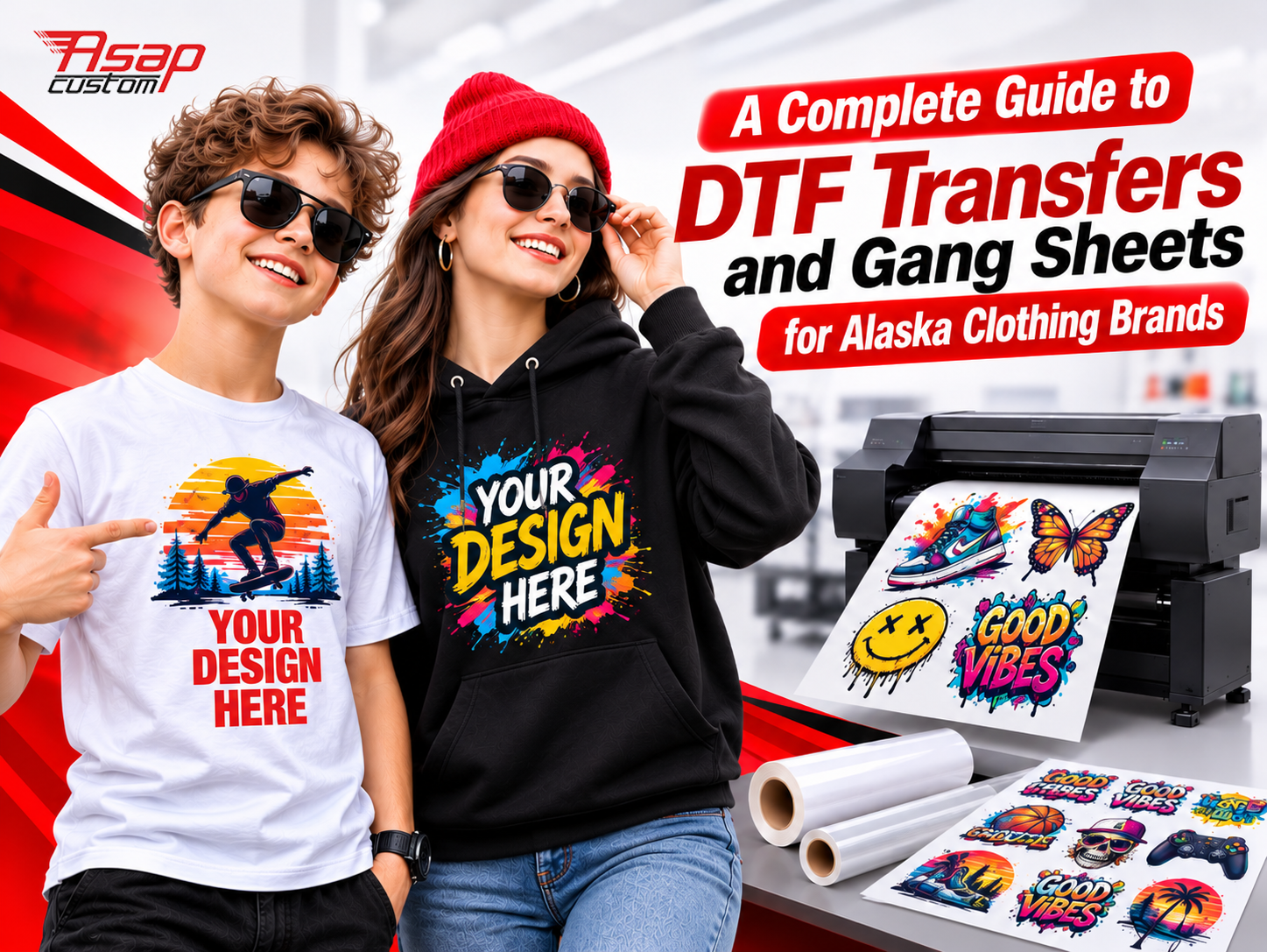
What are DTF transfers?
DTF stands for direct-to-film. A design is printed onto a transfer film and prepared for application to compatible apparel using a heat press. This allows a decorator or clothing brand to prepare artwork separately and apply it to garments as needed.
DTF transfers can be useful for small brands, print shops, event organizers, and businesses that need full-color designs. They can also help when a customer wants several designs or garment sizes without ordering a large quantity of pre-decorated shirts.
Transfer quality depends on the film, ink, adhesive, artwork, application equipment, settings, and garment. Follow the supplier’s instructions for the exact transfer product.
What is a gang sheet?
A gang sheet places multiple designs on one larger transfer sheet. Instead of ordering each graphic separately, a customer arranges several logos, names, or artwork variations within the available print area.
Gang sheets can help organize a production run and make efficient use of transfer space. They are especially useful when a business needs different designs, sizes, or placements for a collection of garments.
Before creating a gang sheet, confirm the available width and length, required spacing, file format, and whether the supplier offers layout assistance. Keep designs separated enough for easy cutting and handling.
Prepare artwork correctly
Use high-resolution artwork with clean edges. Transparent PNG files are commonly used for DTF, but providers may also accept vector files or print-ready PDFs. Confirm the exact upload requirements before submitting.
Set every design to its intended print dimensions. A logo for a left chest is usually much smaller than a full-front graphic. Measure the available print area on the garment and avoid relying on how large the artwork looks on a monitor.
Remove unwanted backgrounds and stray pixels. Check text, spelling, color, and orientation. Make sure transparency is genuine and not a white rectangle behind the design.
Very thin lines and tiny text may not reproduce as expected. If your design includes fine detail, ask the supplier to review it before printing the full gang sheet.
Plan your Alaska apparel production
For Alaska-based brands, ordering transfers can be one part of a broader production plan. Consider where garments will be sourced, where transfers will be applied, and how finished products will reach customers. If transfers are shipped to another town, include shipping time in the production schedule.
Order enough transfers for the planned garment quantity, but check whether the supplier offers replacement policies for damaged or misprinted sheets. Confirm the shipping method, estimated dispatch date, and delivery estimate before committing to a customer deadline.
Keep a record of transfer dimensions, artwork version, garment type, and application settings. This helps make repeat orders more consistent.
Apply transfers using the supplier’s settings
A heat press is commonly used to apply DTF transfers. Temperature, pressure, press time, peel stage, and any finishing press vary by transfer system. Use the supplier’s exact instructions rather than a generic setting found online.
Position the transfer carefully and make sure the garment is flat. Use recommended protective materials and check that the press surface is clean. Follow the stated peel instructions and avoid extra heat unless the supplier directs it.
If a transfer lifts, wrinkles, or appears uneven, stop and check the application process before continuing with the batch. Test on one garment when using a new fabric or transfer product.
Care and quality control
Follow the garment and transfer care instructions. Washing inside out and using the recommended wash temperature may help protect decorated apparel, but the correct care process depends on the product. Avoid promising a fixed wash life unless supported by testing for the exact transfer and application conditions.
Inspect finished garments for placement, alignment, color, adhesion, and visible defects. For business or wholesale orders, create a quality-control checklist and retain one approved sample for future reference.
Store unused transfers in the environment recommended by the supplier, protecting them from moisture, dust, excessive heat, and direct sunlight where applicable.
Before you place an order
Confirm sheet dimensions, file requirements, artwork sizes, quantity, garment type, application equipment, shipping address, and deadline. Ask whether the quote includes gang-sheet layout, cutting, or artwork preparation.
ASAP Custom lists DTF printing among its apparel decoration services. Contact the team with your artwork and project details to confirm current transfer formats, sizes, pricing, and shipping availability across Alaska.
Frequently Asked Questions
What is a DTF gang sheet?
A larger transfer layout that holds multiple designs together on one sheet of film.
What file format should I use?
A high-resolution transparent PNG is common, but exact requirements vary. Confirm accepted formats, dimensions and resolution with the supplier.
Can DTF transfers be applied to every fabric?
No. Compatibility depends on the garment material, finish, and transfer system. Confirm suitability and test unfamiliar garments.
How do I apply DTF transfers?
Use a heat press and follow the supplier’s exact instructions for temperature, pressure, time, and peel method.
